
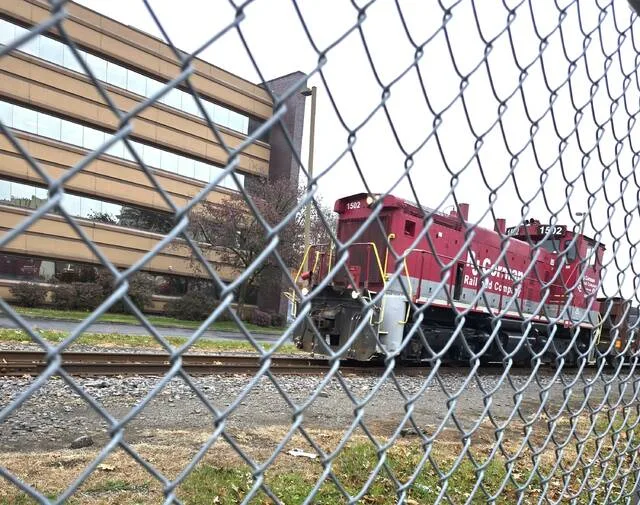
Luzerne County and other defendants fired back in federal court against an effort to stop the sale of the county’s rail line to Reading and Northern Railroad.
The sale closing is on hold until the court rules on a preliminary injunction request filed by R.J. Corman Railroad Co., which was not selected to purchase the line. Its Oct. 2 complaint makes strong allegations about the fairness and legality of the entire process to sell the line and seeks to void the sale agreement.
Response briefs were due Monday from the defendants: the county; the 11 County Council members in their official capacity; citizen members of a county administration-authorized panel that made a nonbinding recommendation on which company it would select (also named as defendants in their official capacity); the county Redevelopment Authority that owns the line; Reading and Northern; and the authority-affiliated Rail Corp. that has a rail operator agreement with R.J. Corman.
Attorneys representing the county, the council, and the citizen panel jointly filed a 53-page brief presenting legal arguments on why the federal court should not grant the plaintiff’s attempt “to hold hostage millions of dollars of public funds” through an “unmeritorious lawsuit.”
The filing said no competitive bidding laws were violated because the request for purchase offers, known as an RFP, identified numerous factors that could be considered in assessing proposals, including anticipated job creation, rail infrastructure improvements, and service expansion.
“The RFP does not state the proposal with the highest offer price would be accepted and awarded,” it said. “The RFP states a proposal can be rejected for any reason and does not guarantee that any proposal would be accepted and awarded.”
The Redevelopment Authority must comply with the Urban Redevelopment Law, which does not require the authority to engage in competitive bidding to sell property, it said.
“A redevelopment authority must consider other qualitative factors to fulfill its designed purpose to achieve socially and economically sound redevelopment,” the filing said.
Instead of federal court, it said the plaintiff could and should have filed any objections to the Surface Transportation Board, a federal entity that has jurisdiction over rail line sales. Reading and Northern has already filed paperwork through its Wilkes-Barre Terminal Railway Co. seeking board clearance for acquisition and operation exemption, according to the board’s site.
The filing argues the “extraordinary remedy” of an injunction should not be granted because the plaintiffs did not demonstrate a reasonable likelihood its claims will succeed on their merits in the “baseless lawsuit.”
It cited reasons federal court lacks jurisdiction over the matter and maintains the plaintiff “intentionally rushed into this court knowing the Surface Transportation Board held jurisdiction over its claims.”
R.J. Corman’s claims that the citizen recommendation panel and County Council violated the state Sunshine Act are not valid, it said. The panel members do not “fit the definition of a public agency” under state law, it asserts. Regarding the council, it said a quorum did not deliberate outside public meetings, and all official action was taken through public votes.
It also replied to R.J. Corman’s argument that the sale could attempt to include or negatively impact track that R.J. Corman — not the authority — owns in the Grimes Industrial Park in Pittston Township that connects shippers to the county line and carries approximately 37% of all carload traffic on the county line.
The county filing said this argument is a “red herring” because the RFP does not include the Grimes Industrial parcel.
“Plaintiff knew this before it filed its lawsuit, and merely incorporated allegations as to Grimes Industrial Park to feign an emergent issue,” the filing states.
The plaintiff’s concerns about losing business and investments it made in the rail infrastructure are “classic concerns about money, which cannot form a basis for injunctive relief,” it said.
“The parties and the public have an interest in ensuring that federal courts do not needlessly interfere with lawful proceedings pending elsewhere,” it said.
Several Elliott Greenleaf attorneys are representing the county defendants.
The county, authority, and Rail Corp. agreed to sell the line in a settlement agreement tied to litigation the county filed in the County Court of Common Pleas over $3.28 million it is owed by the authority. This agreement gave the council power over which entity acquires the line.
The council had unanimously vetoed the original authority/Rail Corp. decision to sell the line to R.J. Corman for $8.2 million, which prompted the second choice of Reading and Northern recommended by the authority and Rail Corp. and accepted by a council majority.
Reading and Northern offered a $10 million package — $7 million cash at closing plus $3 million for track-related rehabilitation services to be spent during the first three years — in addition to a commitment to make upgrades to provide recreational passenger-train excursions from a depot in Wilkes-Barre.
Before the initial recommendation of R.J. Corman, a citizen panel reviewed the proposals and recommended Reading and Northern.
Redevelopment Authority/Rail Corp.
Both entities filed responses indicating the R.J. Corman filing makes no claims of wrongdoing by them.
As a result, both entities said they are “nominal” defendants and not taking any position on the claims made against other defendants.
Reading and Northern
Represented by attorneys from Joyce, Carmody & Moran P.C. in Pittston, the rail company cites many similar arguments made in the county filing on why the injunction request should be denied.
None of the plaintiff’s arguments establish that the authority or Rail Corp. “departed from the RFP’s stated criteria or otherwise acted unlawfully,” it said.
“Plaintiff’s arguments instead invite the court to reweigh the proposals, elevate purchase price above the other announced objectives, and substitute its judgment for that of the entities responsible for evaluating the competing proposals,” the filing said.
Next step
U.S. District Court Judge Julia K. Munley is presiding over the matter.
A two-day hearing on the injunction motion is set to start at 10:30 a.m. Thursday in federal court in Scranton.