
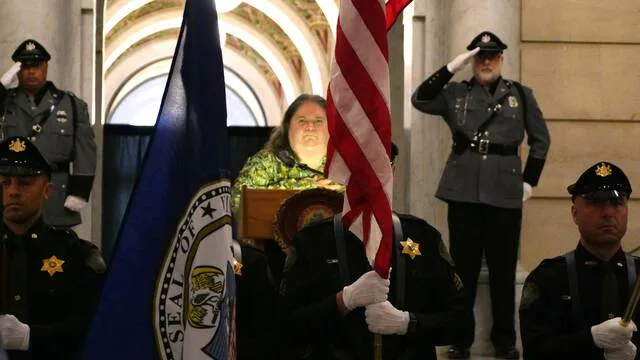
In a solemn Friday morning ceremony, two Luzerne County officials — Councilwoman Dawn Simmons and Manager Romilda Crocamo — described what it was like to be in New York City as the 9/11 terrorist attack occurred 25 years ago.
Simmons said the act of preparing her remarks required her to “open a door to memories” that she has “learned to carry quietly for many years.”
”They are very personal, and I will admit that opening that door has been very emotional. But today, I open it because remembrance matters,” Simmons told the group gathered in the county courthouse rotunda in Wilkes-Barre.
According to her account, the day began like any other busy weekday morning. She got her son, Gregson, off to school before rushing to catch the Metro-North train into Manhattan — late, as usual — for work as a paralegal at a law firm on East 40th Street.
She arrived in the city around 8:40 a.m. and focused on getting to the office, “not yet aware that history was changing” around her at that moment.
As she reached the corner at East 40th Street, she had a clear view toward Lower Manhattan and saw a large plume of smoke rising into the sky near the Twin Towers and saw “another speck in the sky, moving terribly close to the other building.”
“But my mind could not comprehend what my eyes were seeing, so I kept walking and reached my desk around 9:05 a.m.,” she said.
A few minutes later, “everything changed” as she and her colleagues scrambled to process the information coming in and reach out to loved ones. Her bosses tried to keep everyone calm and instructed them to keep working.
Simmons contacted her mother and asked her to get her son from school, but she could not reach her brother working near the Twin Towers or her best friend, an accountant working in the South Tower.
Against her bosses’ wishes, Simmons put her sneakers back on and left for home.
“By the time I stepped back outside around 10 a.m. that morning, New York City was unlike anything I had ever seen,” she said.
Subway service had stopped, and the few running buses were too packed. Cell phone calls weren’t connecting.
People who had escaped from Lower Manhattan were already making their way into Midtown, some covered in gray ash that was drifting through the city. Burnt office papers floated through the streets, and the smell of burning filled the air.
“There are certain things that 25 years cannot erase, and that smell is one of them,” she said. “It was the smell of death.”
Simmons walked for two hours before she found a bus in the Bronx to get home.
During that fearful journey with strangers, she witnessed people helping each other, including some picking up and carrying an elderly woman, as emergency response vehicles sped “toward the danger.”
Nobody cared about race, religion, nationality, politics, or income, she emphasized.
“In that moment, none of those things mattered. We were human beings trying to help other human beings,” she said, adding that it is one of the things she chooses to remember 25 years later.
Hours later, she learned her brother and friend were safe. Her friend made it down from the 91st to the 45th floor when her tower was struck, and some of her coworkers stayed and did not make it out.
Another friend was at the site as a first responder and helped deliver a baby.
Refusing to allow “hatred and terror to have the final word” in her memories, Simmons said she chooses to remember those impacted, the courage and kindness she witnessed, the birth of a baby amid devastation, and the way everyone came together as Americans.
“We still need one another,” said Simmons, a veteran who resides in Wilkes-Barre. “Our differences do not have to divide us. Our humanity is greater than the things that separate us, and love expressed through service, sacrifice, compassion, and courage is stronger than hatred.”
Crocamo said 9/11 was one of the moments that “divide[s] your life into before and after.”
The first plane hit the center’s North Tower while she was riding the elevator up to the 72nd floor of the Empire State Building, where she worked as an attorney.
Believing it was an errant plane, she called a friend to report she was fine and turned her chair to see the second plane glide into the South Tower.
She emerged from the building to find traffic in disarray, police with guns raised, screaming for them to get out, crowds of people, and fighter jets flying overhead.
The North Tower fell when she reached her apartment in Greenwich Village and was walking her dog. She recalled the “collective gasp, and then the collective hush — silence broken only by sirens in the background.”
She walked to a high school friend’s apartment in the East Village, passing a line of people walking “dazed, with a vacant look in their eyes” and covered by the dust that remained in southern Manhattan through February.
The remains of her cousin, Jerry, who worked in Tower Two, were never found.
“A man sitting in a cave thousands of miles away made the decision that I would live, and Jerry would die,” she said.
Like Simmons, she witnessed the “good in humanity” and “everyday heroes” in the aftermath and the way everyone — including those on Flight 93 — “acted as one.”
“We learned something that we were never supposed to learn. The world can change forever before you even know it is happening. The places we felt were safe don’t feel quite as safe anymore. The ordinary felt fragile,” Crocamo said.
Friday’s ceremony included moving music by members of the Northeastern Pennsylvania Philharmonic String Quartet and a slide show of images.
Echoing the message of others, County First Assistant District Attorney Anthony Ross said Americans have always come together following major disasters and tragedies.
In this election season, people are bombarded with “what divides us,” Ross said. He encouraged everyone to remember what unifies them, which is “infinitely stronger.”
County Court of Common Pleas Judge Mark Bufalino said the 9/11 victims should be honored beyond one day by living lives with courage, compassion, and unity.
“Hatred should never have the final word,” he said.
Former Swoyersville mayor Chris Concert said race, religion, and political affiliations did not matter after 9/11.
“We were simply Americans,” Concert said.