
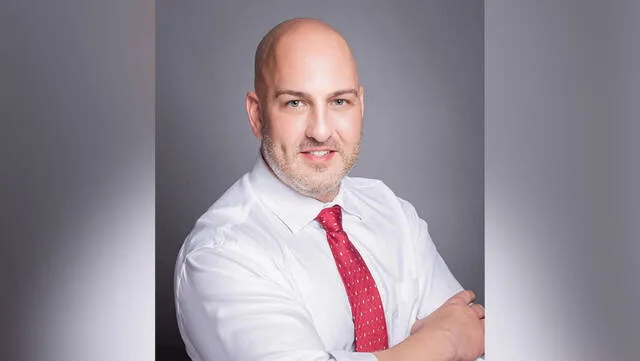
Luzerne County Councilman Chris Belles is asking his colleagues to collectively take a stance against mass surveillance of people and vehicles while also supporting “targeted law enforcement use” of such technology, according to a proposed resolution he released.
Belles said Pennsylvania elected officials have been expressing bipartisan support for restricting camera systems that automatically capture and retain data, and he believes the council should weigh in as state leaders consider policy changes.
“In the United States, we’re supposed to be able to move freely and not be tracked every moment,” Belles said. “We have protections in the Constitution. It’s not to say we have an absolute right to privacy in public places, but something is categorically wrong with turning us into a surveillance state.”
To be clear, County Council has no control over whether such systems are used by municipalities and law enforcement, he said.
A resolution, if advanced, would voice the council’s overall position on the matter and prohibit the installation of mass surveillance on county-owned property, he said. This does not apply to cameras used for security inside and outside county buildings, he said.
As proposed, the resolution would express disapproval of the installation, operation, use, expansion, or government access to any mass automated surveillance system within the county.
It opposes situations in which “innocent residents are routinely identified, categorized, or tracked merely because they drive on a road, walk through a park, enter a building, use a parking lot, attend a public gathering, or otherwise move through daily life,” his proposed wording says.
Belles defines mass automated surveillance systems as cameras, sensors, software applications, databases, analytical services, or integrated networks that routinely or indiscriminately automatically identify or attempt to identify people, personal devices, or vehicles.
The statement of opposition would apply to surveillance occurring anywhere within the county, including roads, sidewalks, transit locations, parking areas, parks, public gathering places, building entrances and exits, building interiors, government facilities, and other public or publicly accessible locations.
His proposal said the formal statement of council policy and intent does not:
• Regulate or command an entity beyond the council’s lawful authority.
• Declare conduct unlawful that is otherwise authorized by law.
• Impair a warrant, court order, documented imminent-threat response, or other lawful investigative action.
Another exception states the council would not be objecting to an ordinary security camera, traffic camera, body-worn camera, or access-control device when these items are used for conventional and lawful purposes. This exception would not apply when devices are used for automated facial or biometric recognition, the identification of people, indiscriminate watchlist screening, cross-camera or cross-location tracking, or the creation of a searchable movement history on people or vehicles not connected to suspected wrongdoing, it said.
“Targeted law enforcement use” of these items would be permitted to locate stolen vehicles, protect missing or endangered people, apprehend wanted or dangerous people, respond to explainable threats, and investigate specific crimes, the resolution indicated.
Continuous or retrospective scanning of crowds, visitors, employees, or the general public and camera-to-camera following of a person should require a “specific lawful basis,” it said.
“Any targeted use should be governed by written rules that limit access to trained and authorized personnel, require a documented official purpose, maintain audit logs, minimize data retention, protect lawful speech and association, and prevent personal, political, or unauthorized use,” it said.
Belles said he has been working on the resolution for months, but was driven to pitch it now because Flock cameras were mentioned during Tuesday’s meeting.
County Councilman Harry Haas made a motion proposing the installation of Flock cameras on county mail ballot drop boxes for round-the-clock monitoring.
Haas’ motion did not come to a vote because nobody seconded it. Haas said he does not support mass surveillance and made the motion because he believes it is “absurd” that a council majority is asking the county Election Board to consider adding more drop boxes.
In response to Haas, Belles said he is vehemently against Flock cameras in general. Haas said he was, too.
Belles said he received strong feedback — all supportive — regarding his public objection to the Flock cameras.
“When I get an overwhelming response from both sides of the political aisle — and independents — I tend to say this is something the public wants,” Belles, a Democrat, said in reference to the council taking a position. “The responses I’ve received tell me there’s a sense of urgency on this issue, and I believe now is the time for council to give people peace of mind on this issue.”
Council Chairman Jimmy Sabatino said the proposed resolution is under review by the county law office, and he expects to place it on the council’s Sept. 22 work session for discussion.