
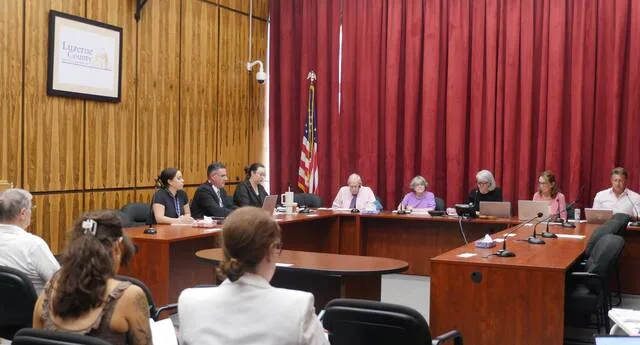
Luzerne County’s new voting system equipment should arrive next week after receiving the required Pennsylvania Department of State certification, county Election Director Emily Cook announced during Wednesday’s county election board meeting.
The board also approved five referendums that will appear on the Nov. 3 general election ballot — four in municipalities and one countywide.
Regarding the voting system, the county had agreed last September to lease new scanners/tabulators and ballot marking devices from Hart InterCivic for use starting in 2026. However, the county had to temporarily use an older version of Hart’s equipment in the May 19 primary because the company was still awaiting required state certification for its new Vanguard model.
Hart obtained certification earlier this month, Cook said.
Voting systems must be certified by both the U.S. Election Assistance Commission (EAC) and the Pennsylvania secretary of state to ensure they meet current standards. The EAC certification was already approved. The vendor sought state certification in August 2025, and a state spokesperson had said time was needed to review reports and other information in its analysis.
As a result, Hart InterCivic agreed to provide training twice — for both the system that was used in the primary and again for the new one, Cook said, noting the county did not incur additional costs because of the certification issue.
While the old and new systems are “very similar,” Cook said the Vanguard model is more efficient, lighter, and easier for poll workers to set up.
New training for both staff and poll workers is necessary due to slight differences in the equipment, she said.
With the new system, voters fill out selections on paper ballots and then feed them into Hart InterCivic scanners for tallying, reducing the equipment needed. Previously, voters made selections on computerized Dominion Voting Systems touchscreen ballot-marking devices, printed the ballot for review, and then fed it into a tabulator.
One Hart InterCivic electronic ballot marking device must still be set up at each of the 186 voting precincts to accommodate those with disabilities.
Cook said she received positive feedback about the Hart InterCivic system in the primary, with no problems reported. She told the board Wednesday she has been “extremely impressed” with the vendor and expects the same “seamless transition” that the county experienced for the primary.
Board Chairwoman Christine Boyle asked Cook if she has any concerns about implementation for the general election.
Cook said she already met with the vendor numerous times and has “nothing but confidence in the way this is going to be run.”
The county is leasing the Hart InterCivic equipment for $574,000 annually for five years, including equipment, software, maintenance, and support services. The election bureau had projected it will fully offset the lease cost with annual savings using the new system, in part through reduced expenses for equipment transport to polling places and staffing.
Cook also agreed to assume responsibility for in-house ballot design and programming, but she said that transition will occur for the 2027 primary due to the short window until the Nov. 3 general election.
Referendums
The board unanimously passed the four referendums in municipalities.
Three of the referendums ask voters in the townships of Dallas, Sugarloaf and Jenkins if they want to increase the number of elected supervisors from three to five. The other referendum in Hazleton asks city voters if they want to adopt or reject a home rule charter drafted by an elected city study commission.
The board also approved explanations of the ballot questions, commonly known as a “plain English statement,” that must be placed in the official election notice and posted at each polling place.
The fifth countywide referendum prompted lengthy debate and was ultimately approved by four members, with Board Vice Chairman Rick Morelli voting no.
Submitted by Fairview Township resident Alisha Hoffman-Mirilovich, executive director of Action Together NEPA, the referendum asks voters if they want to amend the county home rule charter to ban county elected officials and employees from engaging in individual stock trades or prediction market bets based on nonpublic information obtained in the course of their official county service.
It would also require annual county reporting of ethics complaints and stock trades involving county, state, and federal elected officials representing the county.
Morelli raised concerns about the clause requiring county reporting of trades by state and federal officials representing the county, arguing those offices should be itemized for voter clarity because he believes the wording is “too broad and vague.”
Other board members expressed concerns about the legality of tinkering with the wording stated on the voter petition submitted in compliance with state law to place the question on the ballot.
Hoffman-Mirilovich told the board more than 23,000 voters signed the petition, and there could be litigation if the board makes substantive changes to the referendum question.
Although the referendum and associated statement were approved, Morelli requested a legal review of the proposed referendum.
Drop box review
Following past protocol for board spot-checks of drop boxes, Boyle and Board member Audrey Serniak reviewed footage and other data from this year’s primary election, Boyle reported.
At the box in the county Penn Place Building lobby in Wilkes-Barre, they found 10 instances in which voters deposited two ballots and two instances of voters depositing three, she said. They determined most involved voters dropping off ballots with the same family surname or physical address, Boyle said.
The information was forwarded to the county district attorney’s office. Because no action was taken, the ballots were processed with others during post-election adjudication, Boyle said.