
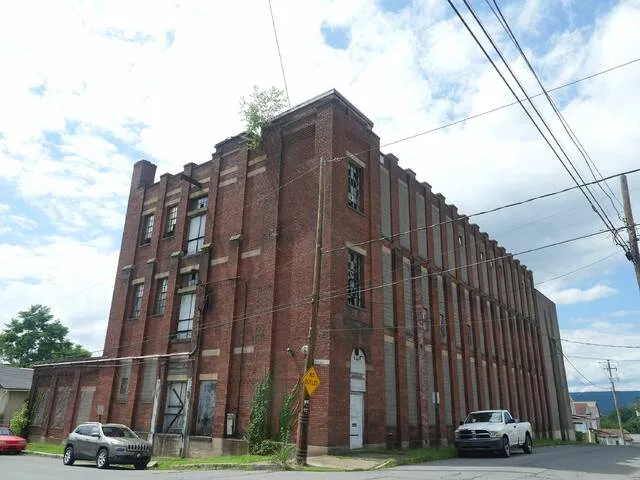
The nonprofit owner of a cavernous, condemned former factory in Wilkes-Barre plans to seek a Local Share Account grant from casino gambling funds to tear down the structure so the cleared lot may be used for an affordable senior housing project.
Alex Zbinovsky, of the nonprofit owner NEPA Community Development Corp., appeared before the Luzerne County Redevelopment Authority Board Tuesday to request its sponsorship of the grant application.
The authority board tabled the request, saying Zbinovsky must provide the board with a formal written grant application that includes a firm estimate on the asbestos removal and demolition costs.
Zbinovsky said he will promptly submit all required paperwork so the board can vote on whether it will submit the application on his behalf before the September deadline.
He estimated $250,000 is needed for the environmental remediation and demolition but said that figure may increase based on an updated evaluation.
The 43,000-square-foot brick, three-story property in the 400 block of New Grove Street was occupied by several companies in the past, including Rex Laboratories in the 1970s.
Zbinovsky acquired it in 2013 from the county repository, a pool of tax-delinquent properties that are available cheap because no bidders wanted them in two prior auctions.
He originally planned to rehabilitate the building but said he was unaware of its poor condition because repository buyers are not permitted to enter structures to inspect them in advance. Most of the roof has caved in, he said.
Wilkes-Barre condemned the structure in 2023 but declined to assist him in tearing it down, he said.
While some have advised Zbinovsky to stop paying the property taxes and walk away, he said he wants to return the site to productive use because he is an “ethical person.”
“I’d rather take care of it before I leave,” he said.
He is one of the shareholders of Future Horizons-Hanover LTD, which owns an adjacent vacant, 3.25-acre parcel that falls in Hanover Township. That land may also be part of the senior housing project if the township is agreeable, he said.
After demolition, Zbinovsky said he would seek federal and state grants that are available for the construction phase.
He is concentrating on housing for local seniors 65 and older due to the need, stressing the income-based rental units would be affordable and not categorized as low-income housing.
Adjacent property owners would be included in discussions about the project as it develops, he said.
Residents had objected in 2006 when Volunteers of America proposed demolishing the factory to build an independent living facility for young adults, according to past reporting.
Rail sale
Authority officials said they continue working with the county government on the upcoming submission of proposals to purchase the county rail line.
The authority owns the line, and the authority-affiliated Rail Corp. maintains a lease agreement with a rail operator. Both entities entered into a settlement agreement with the county that includes the sale of the line. County Council had initiated the litigation against the authority and Rail Corp. in July 2025 over an outstanding $3.28 million loan the county had provided for the rail acquisition.
Purchase offers are due Aug. 28, and the county will have the right to reject any bid for any reason.
Unless all responses are rejected, the purchase award will be issued within 15 days of the submission deadline. Closing must occur by Oct. 9.
According to the request for proposals, approximately 27 miles of the 56 or so miles of track are actively in use for train operations. The request is structured to allow separate offers to acquire inactive sections that could be used for recreational trails in the future.
Sale proceeds must first be used to pay off the authority’s outstanding loans to the county and cover county legal fees and costs associated with preparing the request for proposals and carrying out the sale. If any proceeds remain after those payments, the county and authority/Rail Corp. would receive percentages based on a formula.