
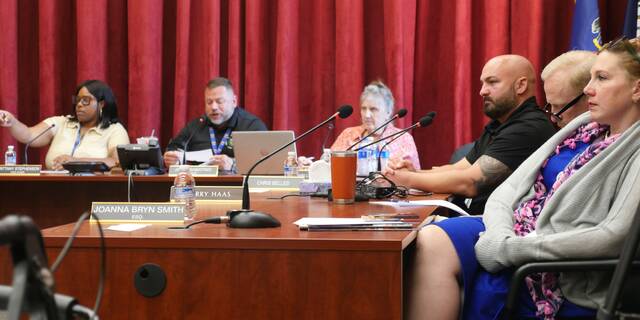
Luzerne County Council is poised to vote Tuesday on a sweeping anti-discrimination ordinance that would impact businesses and entities outside county government itself, warranting further explanation of specifics.
One component — the composition of the entity that would adjudicate discrimination complaints — is also unclear at this time.
The proposal up for adoption on Tuesday creates a county human relations commission to rule on discrimination complaints, but the commission’s composition was not part of the package and will be addressed separately at a later date.
Several citizens pointed out this unknown during last week’s required public hearing on the proposed legislation.
Prior county controller Walter Griffith questioned who would be on the commission and whether they would be unbiased and nonpolitical.
Hazle Township resident Sandra DeBias also asked about the membership of the commission “tribunal” and the eligibility requirements to serve.
County resident Katrina Domkowski said in a written comment that she fully supports discrimination prevention but has concerns about the ordinance as drafted, including a lack of clarity on the commission’s independence, qualifications, conflicts of interest, and transparency.
“Because Luzerne County itself, county agencies, local authorities, political subdivisions, school districts, and private businesses may all fall within the scope of the ordinance, it is critical that the Commission be insulated from political influence,” Domkowski wrote.
Council Chairman Jimmy Sabatino said a proposed ordinance on the commission makeup was not introduced simultaneously to save time and energy because it would only be needed if the anti-discrimination ordinance passes.
Who must comply
The ordinance prohibits discrimination in areas of employment, education, healthcare, the rendering of services in places of public accommodation, and housing.
A series of definitions for the entities that must comply are in the 21-page proposed ordinance attached to last week’s public hearing agenda at luzernecounty.org, including:
• Employer — any person or organization employing one or more workers, excluding parents, a spouse, or children. This also applies to county government, municipalities, and school districts. The ordinance does not apply to the judicial branch of government or “any entity where application would violate the separation of powers under the Pennsylvania Constitution.”
• Educational institution — a public or private education provider, charter school, college, university, trade or training school, preschool, daycare provider, or other educational entity.
• Healthcare provider — a licensed healthcare provider, including medical doctors, osteopaths, dentists, podiatrists, optometrists, opticians, chiropractors, psychologists, social workers, pharmacists, nurses, midwives, emergency medical technicians, radiologists, X-ray technicians, therapists, physician’s assistants, and dental hygienists. It also covers group or institutional healthcare providers such as hospitals, skilled nursing and assisted living facilities, clinics, laboratories, home healthcare providers, medical offices, and their employees.
• Public accommodation — places open to the general public that offer goods and services, including loans and entities or individuals that provide transportation for compensation.
• Real estate-related transactions — in addition to loans for residential and commercial property, it includes the selling, brokering, and appraising of property.
• Housing accommodations — any building, structure, mobile home site, hotel, motel, campground, shelter, dormitory, or facility used, occupied, or intended to be occupied as the home residence or sleeping place of one or more individuals, groups, or families. It does not include an owner-occupied rental in which personal living space will be shared with the owner.
Protected class
The general ordinance description lists the following in the protected class and elaborates on some with separate definitions:
Actual or perceived race, ethnicity, color, religion, creed, national origin or citizenship status, ancestry, sex (including pregnancy, childbirth, and related medical conditions), gender identity, gender expression, sexual orientation, genetic information, marital status, familial status, GED rather than high school diploma, physical or mental disability, relationship or association with a disabled person, source of income, age, height, weight, veteran status, use of guide or support animals and/or mechanical aids, and domestic or sexual violence victim status.
Hairstyles associated with an individual’s culture or religion are also protected, including locs, braids, twists, coils, Bantu knots, afros, extensions, wigs, and payot.
Some specifics from the supplemental definitions:
• Age — over 35
• Disability — includes AIDS and long COVID
• Gender expression — the external appearance of one’s gender identity, usually expressed through behavior, clothing, haircut, voice, chosen name, and/or pronouns.
Banned action
The ordinance prohibits exclusion, denial, intimidation, coercion, and difference or segregation in treatment because of an individual’s membership in a protected class.
It extensively details prohibited actions for each sector, along with exceptions in some cases.
For example:
• Public accommodations cannot directly or indirectly refuse services to anyone because of protected class.
Breastfeeding mothers cannot be prohibited from or segregated within a public accommodation where they would otherwise be authorized to be.
An exception says people cannot be required to “create speech or artistic expression which is contrary to their sincerely held religious beliefs.”
• The employment section said employers cannot fire, refuse to hire, or otherwise discriminate against someone based on a protected class if the employee or independent contractor is the “best able and most competent to perform the services required.”
• Regarding healthcare, the ordinance said providers cannot, based on a protected class, refuse or limit access to treatment, surgery, medication, health insurance benefits, participation in health programs, or access to other healthcare services. Treatment prohibited under state and federal law is excluded, it noted.
• Educational institutions could not refuse access to enrollment, equal treatment, participation in programs, or otherwise discriminate against students, families, or workers based on a protected class.
• On the topic of real estate, residential and commercial property sales, rentals, and financing cannot be denied due to someone’s protected class.
A disclaimer is included in the ordinance saying nothing in it “shall be construed to require” anyone to violate existing municipal, county, state, or federal laws.
If the commission deemed a complaint within its jurisdiction, it would send a copy to the respondent and require a written response within 60 days.
A commission investigator would determine if there is probable cause that an unlawful practice has occurred and present findings to the commission for further proceedings, which could include mediation and/or a public hearing.
Violators can be found guilty of a summary offense and, upon conviction, be sentenced to pay a fine ranging from $100 to $500, it said. The county also may seek recovery of attorney fees and other investigative costs, it said.
Tuesday’s meeting is at 6 p.m. in the county courthouse on River Street in Wilkes-Barre, with public comment on this issue permitted at the start of the meeting. A link for the remote attendance option will be posted in council’s online meeting section at luzernecounty.org.